

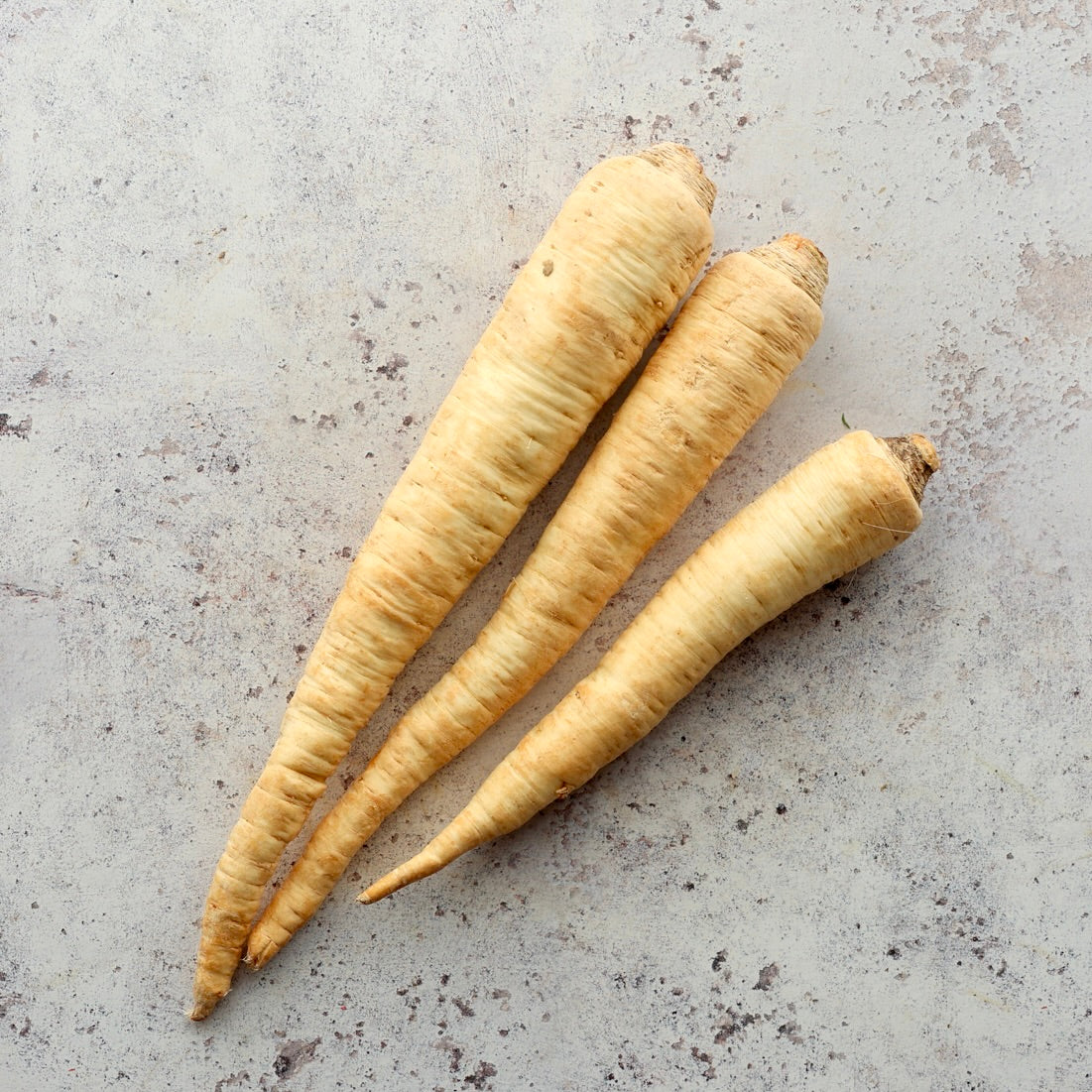
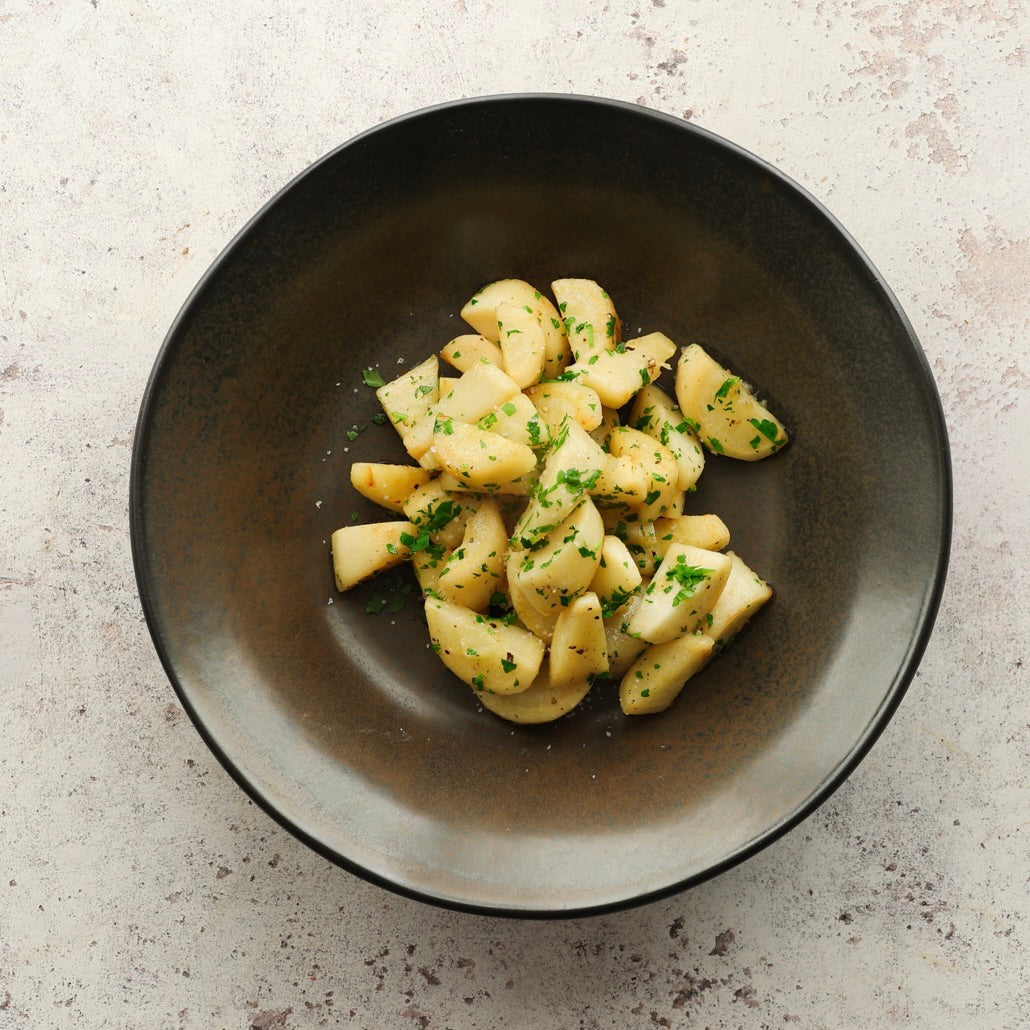
Parsley Root
Choose options
Parsley root (Petroselinum crispum var. tuberosum) — also called Hamburg parsley — is a root vegetable that is the same species as the flat-leaf and curly parsley used as a herb. The difference is that this variety has been selected over centuries for its root rather than its leaves: the plant puts its energy into producing a large, pale, tapered root rather than a bushy top of foliage. The leaves are still edible and taste like parsley — slightly coarser than a dedicated leaf variety, but perfectly good chopped into a salad or used as a garnish.
The root looks like a pale, slender parsnip and is easy to confuse with one at a glance. The flavour, however, is distinctly different. Where parsnip is sweet and starchy, parsley root has a cleaner, more herbal quality — there is parsley in the flavour, unsurprisingly, but also celery, a slight nuttiness, and a more delicate sweetness than parsnip. The texture when cooked is smooth and less fibrous than parsnip, which makes it particularly good for purées and soups where a silky consistency matters.
Parsley root is a staple in Central and Eastern European cooking — it is one of the core root vegetables in Polish, Czech, and German soup bases, where it sits alongside celeriac, carrot, and leek. In this context it is a foundation ingredient rather than a feature, providing depth and backbone to a broth. In the UK it remains relatively uncommon, which is difficult to explain given how well it grows in the same conditions as parsnip and carrot.
Store in the fridge wrapped loosely in a damp cloth or paper, and use within a week. The roots will soften and go limp if left unwrapped.
Allergens: Celery (parsley is in the same botanical family — Apiaceae — and falls under the celery allergen category).
Origin: Netherlands
Ingredients: Parsley root (Petroselinum crispum var. tuberosum).
Storage: Refrigerate, loosely wrapped. Use within a week.