

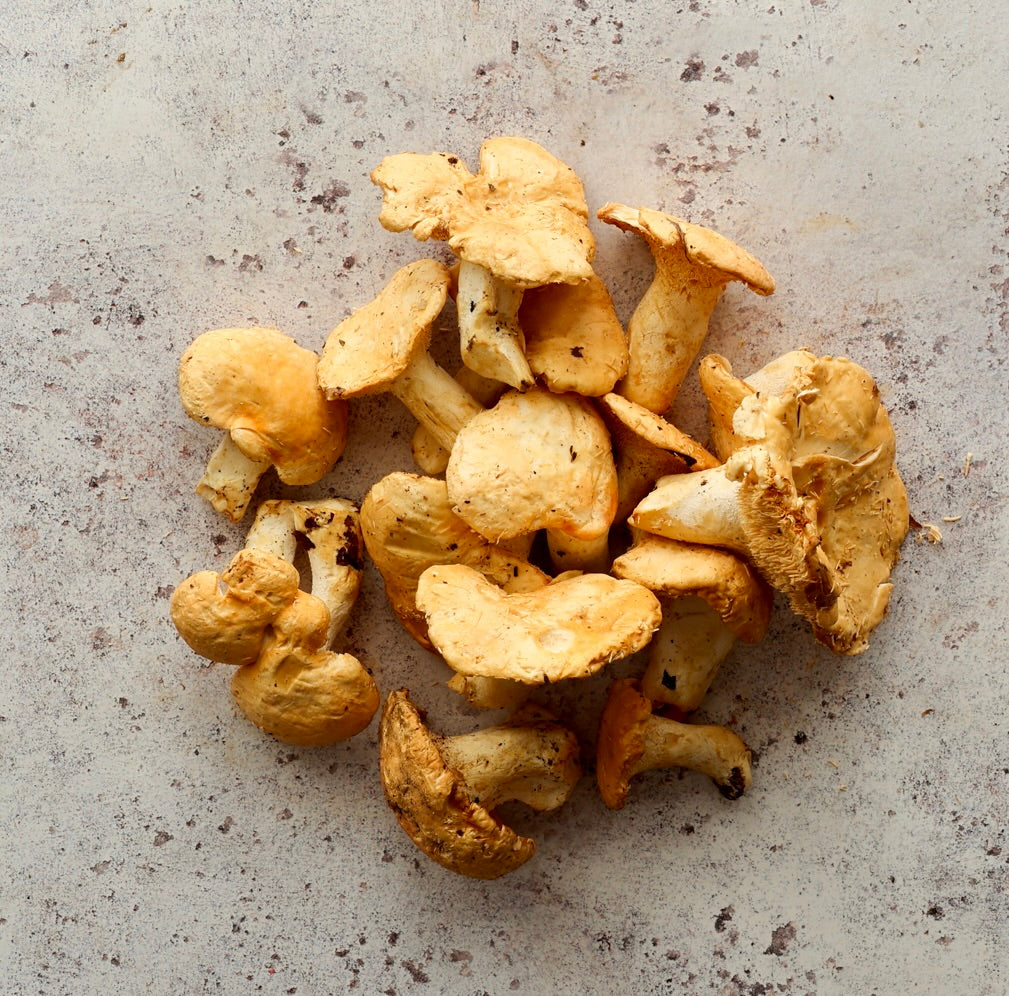
Fresh Pied de Mouton (Hedgehog Mushroom)
Choose options
Pied de mouton (Hydnum repandum) — known in English as the hedgehog mushroom, and in France as pied de mouton (sheep's foot, after the shape of the cap). This is a wild woodland mushroom foraged across European deciduous and mixed forests, and one of the easiest wild mushrooms to identify with confidence because of a single unmistakable feature: instead of gills or pores on the underside of the cap, it has spines.
These spines — short, pale, downward-pointing teeth — are soft and brittle rather than sharp, and they are the defining characteristic of the Hydnaceae family. No toxic mushroom shares this feature in combination with the hedgehog's pale cream-to-apricot cap colour, which is one reason it has long been considered a safe forager's mushroom. The spines become more brittle and prone to snapping off as the mushroom ages, so the cleaner and more intact the underside, the fresher the specimen.
The flavour is mild, sweet, and nutty — less assertive than a cep, less funky than a chanterelle, and without any bitterness when young. Older or larger specimens can develop a slight bitter edge, particularly in the spines, which some cooks trim off for that reason. The texture is firm and dense — closer to a cep than to anything delicate — and holds up well under heat without collapsing or releasing excessive water. This makes the hedgehog a forgiving mushroom to cook: it is difficult to overcook and responds well to a straightforward sauté in butter.
It is a mycorrhizal species — the fungus forms a symbiotic relationship with the roots of nearby trees, exchanging soil minerals for sugars. This means it cannot be commercially cultivated and is only available wild-foraged.
Origin: France
Ingredients: Fresh pied de mouton mushrooms (Hydnum repandum).
Storage: Refrigerate loosely wrapped. Use within 2–3 days.