

Vitelotte Potatoes
Choose options
A French heritage potato with deep violet-purple flesh that runs right through to the centre of the tuber — not just skin-deep colour, but a uniform, almost ink-like purple that holds through cooking. The Vitelotte is one of the oldest named potato varieties still in cultivation, documented in France since the early nineteenth century, though its origins are thought to trace back further to South American cultivars brought to Europe in the colonial period. Alexandre Dumas mentioned it in his Grand Dictionnaire de Cuisine in 1873, and it has maintained a following among French chefs ever since.
The colour comes from high concentrations of anthocyanins — the same class of water-soluble pigments found in blueberries, red cabbage, and black grapes. These pigments are pH-sensitive, which is why the colour can shift slightly depending on cooking method and what the potato comes into contact with — a squeeze of lemon or vinegar will brighten the purple, while alkaline conditions can push it towards blue.
The texture is dry and floury, closer to a King Edward or Maris Piper than a waxy salad potato. The flavour is distinctive — earthy and nutty with a subtle chestnut quality that sets it apart from more neutral-tasting varieties. The dryness makes Vitelotte well suited to roasting, mashing, and gnocchi, where a floury potato performs better than a waxy one. It is less suited to boiling whole for salads, where it tends to crumble.
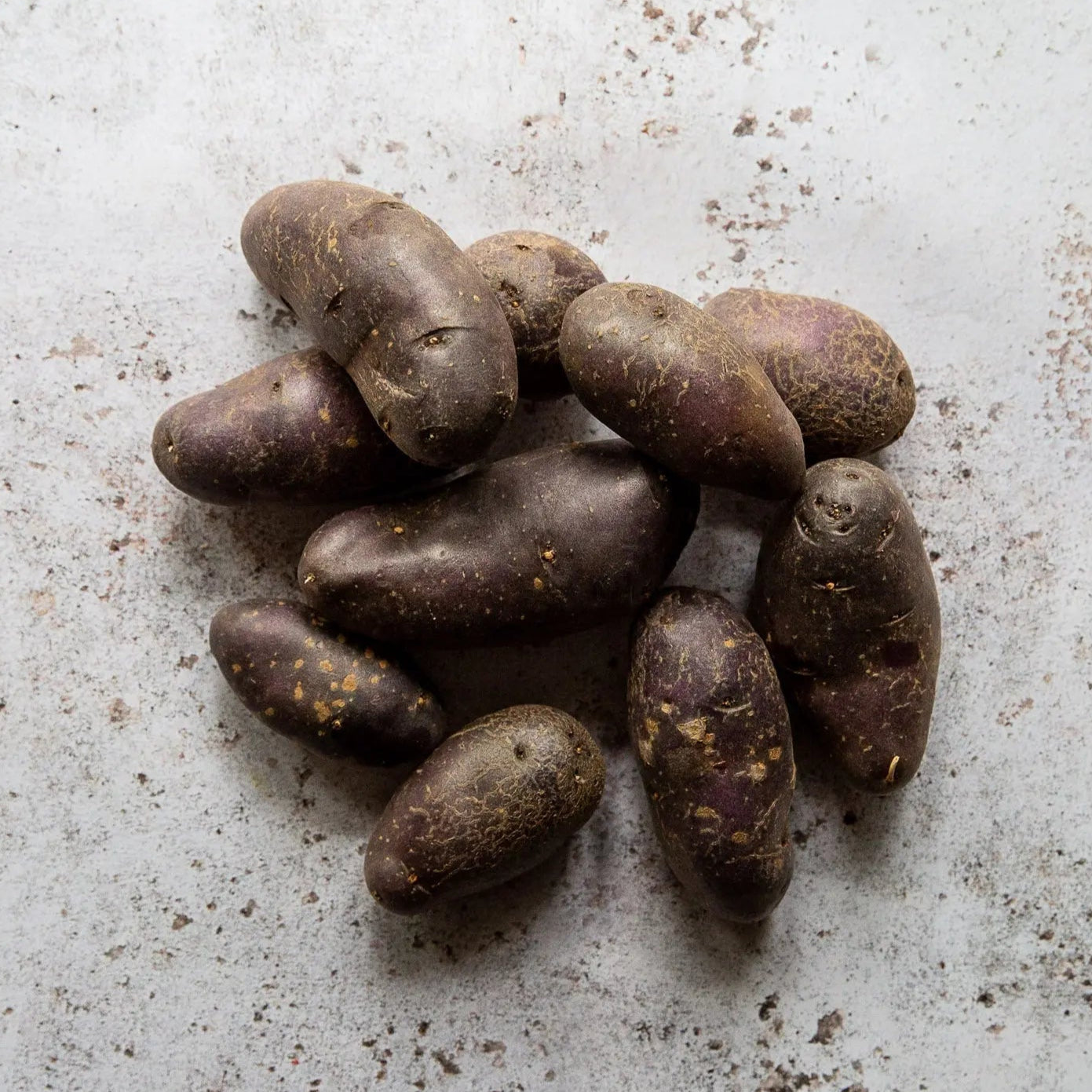
The tubers are small and knobbly with dark, almost black skin — they are not the most elegant-looking raw potato, but the interior colour more than compensates once cut or cooked.
Origin: France.
Ingredients: Vitelotte potatoes (Solanum tuberosum).